

.webp?width=210&height=70&name=StickyLogo%20(5).webp "Swagelok Northern California home page")
Share this
by Morgan Zealear on 2/23/22, 9:00 AM

A computerized orbital welding system delivers clean welds, takes care of lengthy documentation, increases weld efficiency, and decreases the overall production time. But, good orbital welding still relies on human choices. The precise nature of welding demands a careful setup of the power supplies and weld heads to avoid damage. Moreover, the operator's failure to offer proper shielding and hygiene to the workpiece leads to weld contamination and porosity. This knowledge gap can destabilize the production cycle and add more cost to the process in terms of orbital failure. Thus, training employees on advanced orbital welding skills saves time and accounts for more productivity and profit.
It takes less time to decide that your employees need training and more time to choose between the options available. Unlike manual welding, the market offers a limited number of options, mostly by orbital welding setup manufacturers. For most employers, training under manufacturers would develop application knowledge limited to one particular setup. This blog will highlight the key advantages of seeking orbital welding training by equipment manufacturers.
Orbital Welding Training by Equipment Manufacturers: Five Key Benefits to Employers
1. Save Your Time and Costs
Local training is more cost-effective and scalable for a company with any number of employees. You are saving costs related to lodging, boarding, travel, and catering. You're also reducing time on planning and micromanaging these mundane and tedious tasks. While companies save a huge cash flow, employees save more learning time with a local training program. Training in the local area can reduce your employee's time associated with adjusting to a new place. As the program fits your employee's routine lifestyle, it results in improved employee morale.
2. Quality Training
It all comes down to good training from experts. Expertise is what separates amateurs from masters. A renowned manufacturer harnesses deep industry expertise for brainstorming user-friendly design. Research suggests that true expertise has more to do with acquired knowledge. The expertise required to design a bespoke orbital welding setup would cover almost everything from understanding core challenges during initial setup, through power supplies and weld heads, to maintaining logs for future follow-ups. Your vendor’s stand as a subject matter expert in orbital welding can be well perceived from its image as the most accomplished manufacturer. If your vendor is a globally recognized brand, you can rest assured in the quality of training and the transfer of deep industry knowledge from experts to your welders.
3. Workflow Agility
Orbital welding offers precise results as compared to hand welding. You can program variables, automate the process and track progress from a touch screen. However, as with any tool, the quality of work depends on your operator's clear understanding of machine functions and their response to different inputs. The computerized system still needs an operator who knows how to create programs, switch between fixture blocks, position electrodes, and maintain adequate gas pressure. In this regard, nobody knows how to make the machinery perform better than the manufacturer. When your staff learns how to operate the system from the manufacturer, you know that you’re getting the job done better.
4. Quick Feedback
Despite world-class training, it takes a few days of on-the-job practice to get a new welder up to speed. Like any other trainees, novice welders are likely to experience on-site orbital welding challenges, and a small know-how push can help. Occasionally, the unit may halt the process if the situation requires an expert's intervention. In either situation, the freshly-trained batch may look for quick feedback sessions with their trainer for the next couple of weeks until they attain perfection. For a local trainer, attending to an emergency request or periodic follow-up sessions is no big hassle, unlike remote trainers. Moreover, when you go for orbital welding training by equipment manufacturers, you save those extra expenses on hiring an expert again to bridge the knowledge gap between your staff and a master orbital welder.
5. Less Downtime, Increased Productivity
Sending employees too far from the unit adds downtime to your work log. Even emergency situations requiring a trainer's intervention may halt your production until the next day. Equipment downtime costs are hard to keep down. However, with a Northern-California based trainer by your side, you can request in-house training at your facility and expect immediate support of the trainer in person during operational emergencies.
Swagelok Orbital Welding Training Program for Facilities in Northern California
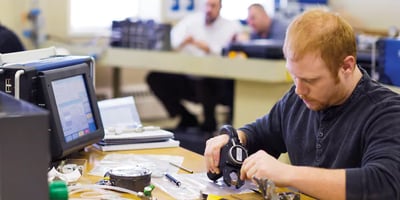 Swagelok, known for producing premium quality welding tools for four decades, offers a five-day intense orbital welding training program to help welders produce quality welds using the Swagelok M200 Orbital Welding System. The course covers basic GTAW principles, M200 setup and operation, common welding challenges and troubleshooting hazards, purge gas setup, tube installation, and visual inspection of orbital welds. By the end of the program, the operator will develop the necessary skills to weld a tubing system without any assistance. Swagelok also offers additional training to prepare trainees eligible for ASME Section IX qualification.
The course deliveries are specifically targeted around expanding the versatility of the Swagelok M200 welding system, including M200 Power Supply, Swagelok Weld Heads, and other secondary Swagelok tools. However, the techniques covered in the course would make the welder eligible to work on any automatic gas tungsten arc welding system independently.
To find out more about how Swagelok Northern California can help you with your orbital welding training and fabrication needs, contact our team today by calling 510-933-6200.

About Morgan Zealear | Product Engineer, Assembly Services
Morgan holds a Bachelor of Science in Mechanical Engineering from the University of California at Santa Barbara. He is certified in Section IX, Grab Sample Panel Configuration, and Mechanical Efficiency Program Specification (API 682), and he is well versed in B31.3 Process Piping Code. Before joining Swagelok Northern, he was a manufacturing engineer at Sierra Instruments, primarily focused on capillary thermal meters for the semiconductor industry (ASML).